

Heneghan’s Birdeye
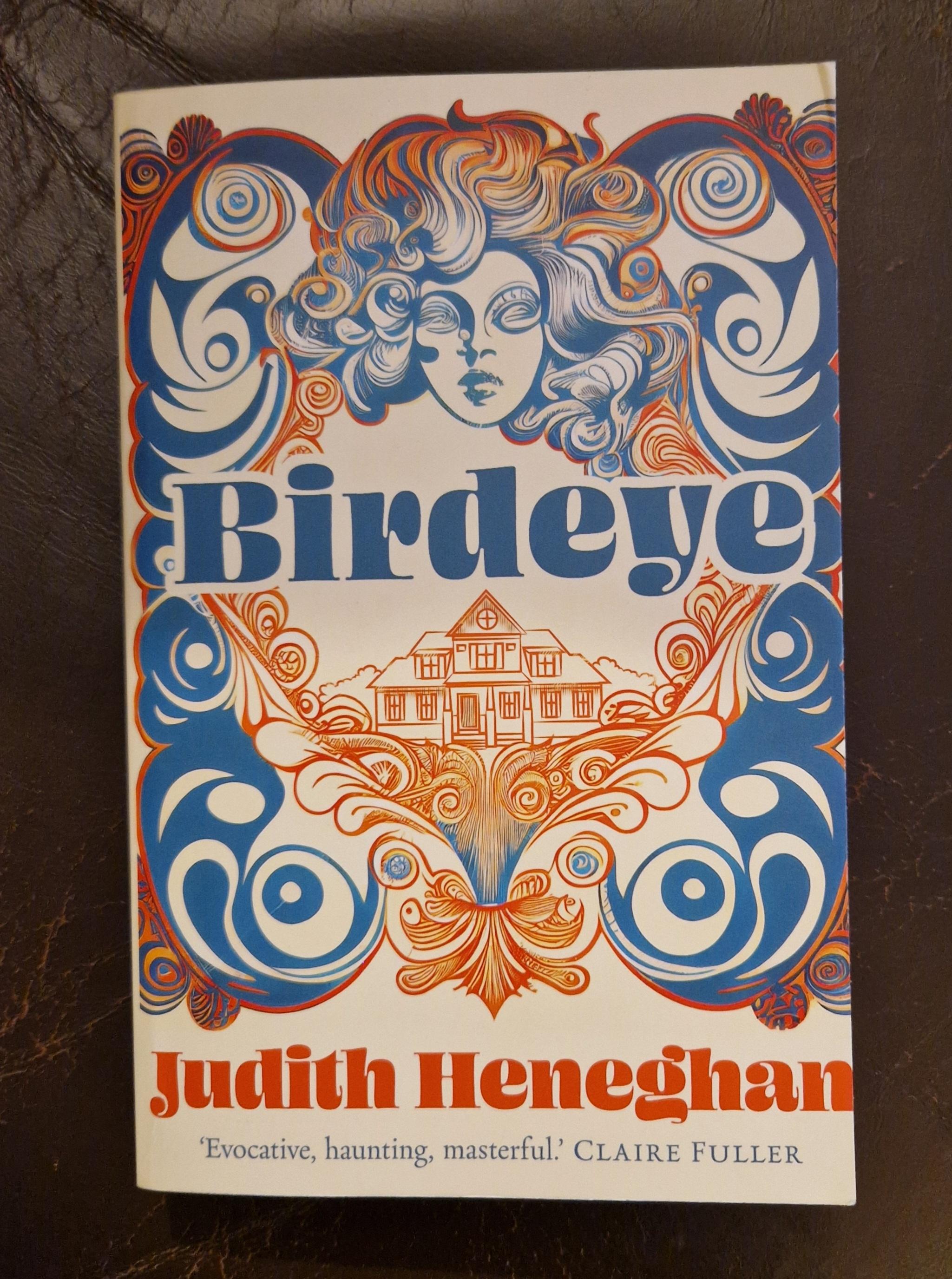
Birdeye is not all it seems. It is about a world that is always both more and less than it seems. It’s set in a hippy commune in the Catskills but that is the least important thing about it – the hippiness has been skilfully used by the author to enable the baring – and concealing – of emotions with greater poignancy than would be possible if she were to depict a more buttoned-up world.
There is a strong sense of fatalism about the circumstances in which the characters find themselves – yet, ironically, each one of their lives has been shaped by two casual sexual encounters that took place decades previously, when hippiedom was at its height.
The central character, Liv, Is in some ways reminiscent of Rachel, the protagonist of Judith Heneghan’s first novel for adults, Snegurochka. (Henegan is also an accomplished children’s author.) Like Rachel, Liv is a strong woman somewhat bewildered by the environment in which she finds herself, yet determined to battle her way through the problems that it throws up. Rachel’s problems, however, are largely caused by the alienness of her situation – she is a new mother trying to cope in a cold and hostile country, with only limited support from her partner – whereas Liv’s problems are the result of the continually shifting nature of the relationships that she has come to rely on. Ironically, she has driven away Eric, the man who was for many years her mainstay, by simply not recognising him sufficiently clearly as an individual in his own right. Eric is still her friend, but he now has another family and has set clear boundaries which Liv may not transgress.
Liv has twin daughters, the product of a fleetingly transient coupling immediately after she left school. Rose, angry and beautiful, is mentally disabled; Mary, practical and clever, has left behind Birdeye and her mother’s adopted country of America to practise law in London. Besides Liv and Rose, the other regular inhabitants of Birdeye are Sonny and Mishti, a brother and sister of mixed white and Indian heritage who are completely committed to each other. They have a dreadful secret that has only been shared with Liv and Eric. With their help, Liv used to run Birdeye as a retreat where guests could come to meditate and find themselves; but its glory days have passed and Sonny and Mishti now wish to seek greater fulfilment by joining another community where their support is needed.
Liv’s world is rocked by Sonny’s announcement that he and Mishti are moving out and the practically simultaneous appearance of Conor, a strange young man who turns up at Birdeye and stays to help, but whose support is tinged with a veiled malice that Liv senses but cannot explain. As the novel unfolds, Conor’s links with Birdeye’s past and the increasingly hostile attitude of the local community to Liv’s ramshackle approach to maintaining the property home in on her in a pincer movement, until she feels trapped. Assistance comes from an unexpected quarter, allowing Liv to reappraise love and friendship through a new lens. Birdeye is about mistakes and redemption; shifting norms and values; the weight of history; the elusiveness of liberation; and what it really means to love. Like Judith Heneghan’s other work, it is beautifully written. It portrays a universe of magical intensity. It wears its symbolism lightly, yet almost no sentence is superfluous, which is why it well repays re-reading. One small example: “If Liv was the roof and floor of the Birdeye House, and Rose, the air within it, then Sonny and Mishti were its four walls, holding everything together.”
 Christina James, crime novelist