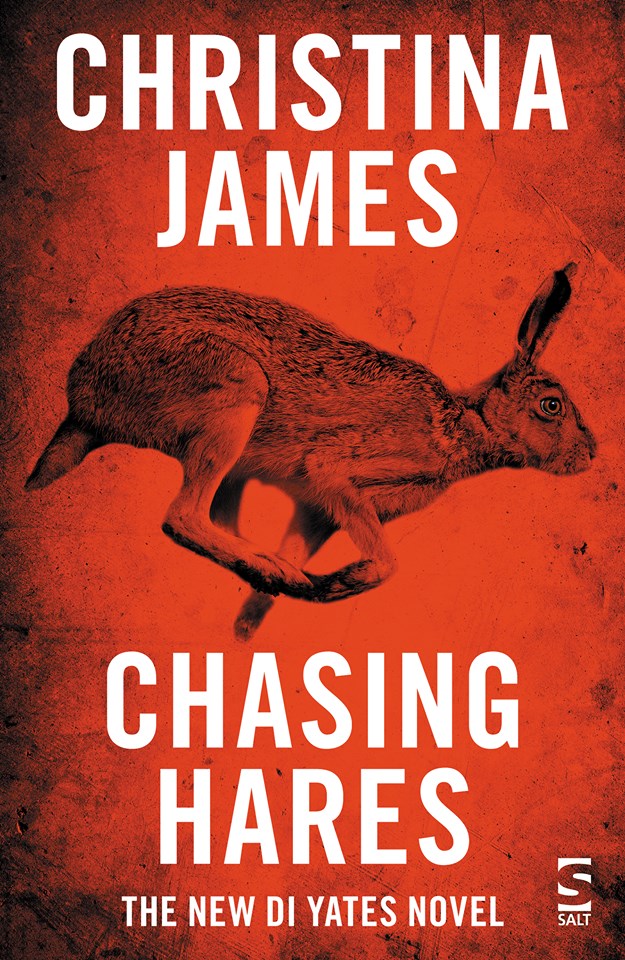


A publication date and a tribute to two very good friends…
In this blog, I try to write mostly about crime-related topics, people, places and things that interest me, aspects of writing and other writers and their work. It isn’t intended merely as a vehicle to promote my own work; this was a conscious decision that I made right at the start, because I quickly tire of blogs by authors who use them too blatantly for this purpose.
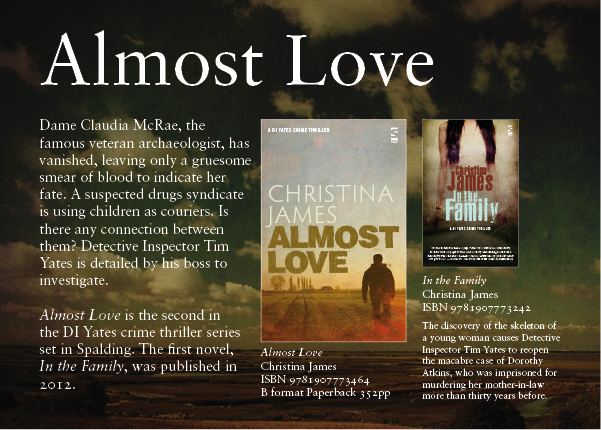
However, I hope that you will look upon today’s post indulgently, because I have to confess that it is indeed about promoting my next book, Almost Love, which will be published on June 15th 2013. It is a promotional piece with a difference, however, because it also celebrates a gift to me by my publisher, Chris Hamilton-Emery of Salt. Before In the Family was published, Chris designed a postcard based on the jacket; I sent this, with a short personal message, to as many people (friends, booksellers, librarians, colleagues) as I thought might be interested in it. I received some lovely replies; it may have helped to generate some interest in the book.
Today, Chris sent a similar promotional postcard for Almost Love. In fact, it features both the novels. I am delighted with it and I think that it is a thing of beauty. I’d like to share it with you; that is why it is the subject of today’s post.
I’d also like to say how much I appreciate Chris and Jen Hamilton-Emery, for their unfailing good-humour and encouragement and also for all their hard work on my behalf. Thank you, both!
The Queen of railway stations…
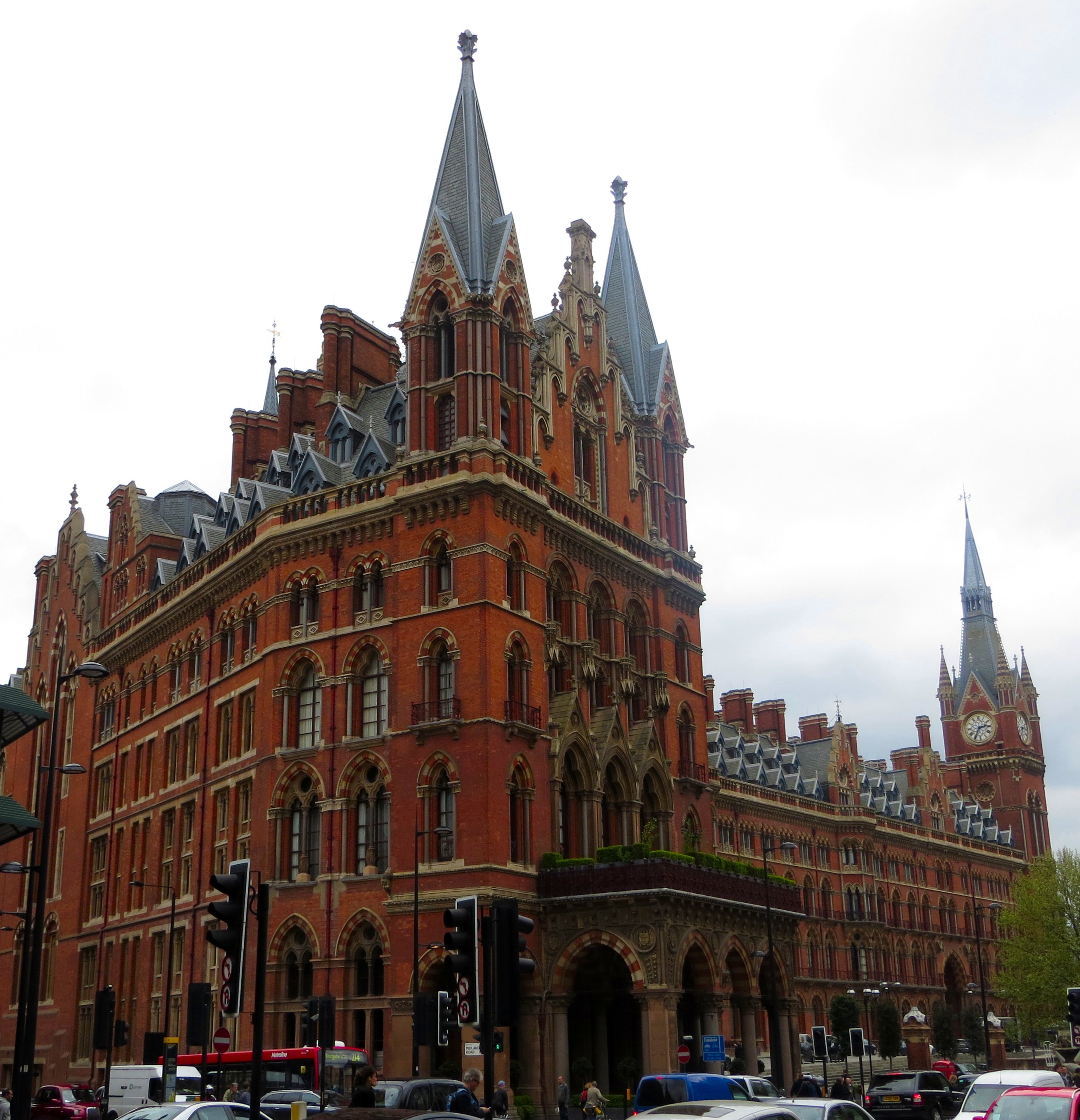
In London again for meetings, I pause as usual to admire the neo-Gothic grandeur of St Pancras Station. More whimsical than a church, as dramatic as if it were a castle towering over some fastness in a remote and mysterious land, it stands, a monument that celebrates the best of Victorian confidence and imagination. Taken as a whole, it could be the setting for a novel by Mervyn Peake; the former Midland Grand Hotel part of it would be the ideal backdrop for a modern take on the country house murder. Each time I see it, I also pay silent tribute to Sir John Betjeman, who was able to perceive its beauty and the poetry of its George Gilbert Scott and William Henry Barlow architecture and who fought to save it from the institutionalised vandalism that caused the original Euston station to vanish – save for its rather forlorn and redundant triumphal arch. Martin Jennings’ marvellous statue of Betjeman conjures both the poet’s and a universal sense of awe at Barlow’s glorious single-span train-shed roof.
Inside, today, St Pancras is a thriving modern business hub. Skilfully renovated, it contains a fascinating parade of shops, cafés and restaurants cunningly chosen to help travellers to pass their time – and relieve their wallets – while they wait for trains. Some of these trains depart for workaday Midlands places such as Birmingham, Wellingborough and Coventry; some go south to Brighton and other holiday destinations. But what really makes this station an exciting place is that it is the main UK terminus for the Channel Tunnel train – ‘Le Shuttle’. Passengers en route for Europe walk with extra purpose in their gait; they carry their luggage with more panache; they wear lighter, brighter clothes. Business-men and -women bound for Lille look less grey and crumpled than those heading for the City; holidaymakers travelling to Paris are glossier than those putting a brave face on going to Eastbourne in the rain. This festive atmosphere is augmented by people playing impromptu on the piano that has been left in the middle of the shopping precinct for the purpose. And – the final touch – announcements through the tannoy system are always relayed in French as well as English.
I wonder how much criminal activity takes place here. There are the usual signs warning passengers to be vigilant against pickpockets; but that isn’t what I’m really thinking of. In what kinds of business activity are the be-suited, glamorous commuters engaged? Are the man and woman dodging through the crowds, she stumbling in four-inch stilettos, he dragging a large case, merely late for a train that will carry them to a romantic destination, or have they just pulled off a lucrative scam and plan to escape by boarding train after train until they have journeyed far to the east?
All stations, even the most prosaically-built, contain a whiff of adventure, of the non-routine that travel implies. In this country, St Pancras is now queen over all the others. If he had lived to dine in the Grand restaurant there, Betjeman would have been happy and proud – and well-fed.
King’s Cross is now enjoying a similar loving makeover. I await the result with impatience and anticipation. It is not difficult to imagine that murder and mayhem took place many times in the murky, disreputable place that it used to be. It was like a malevolent old man in a dirty raincoat. I look forward to seeing a handsome king emerge from all the burnishing, fit consort for the queen next door.
One place, two misfortunes…
In preparation for the weekend festivities, I paid my customary visit to the local farm shop. Situated about three miles from my house, it is a genuine establishment of the genus (i.e., it doesn’t sell tights or sliced bread). It has rather a wonderful selection of local foods, including organically-farmed meat, local cheeses, dairy products and fresh produce. There is also a delicatessen that sells pies, cakes and ready-made dishes from the shop’s own kitchen, as well as more exotic items from further afield – continental sausages and Parma ham, for example, and unusual oils and vinegars. There is a small kiosk between the shop and the delicatessen which opens in summer to dispense Yorkshire-made ice-creams. A recent innovation has been the Thursday morning appearances of the ‘fish lady’, a peripatetic fishmonger who has made an arrangement to park her van next to the shop to sell an impressive variety of fish freshly caught off the east coast. Sometimes she has edible seaweed for sale; it is a particular family weakness.
This is my favourite type of shopping and I realise that, so far, I’ve made it sound pretty idyllic. To strike a more discordant note, the shop has also been the scene of two dramatic episodes in my life, one of which also involved a crime.
The first event happened about six years ago, when I had just finished some work and was in a hurry to prepare for a self-catering holiday due to start the following day. I made it to the shop for provisions about ten minutes before closing time, leapt out of my car, and promptly fell flat on my face. I’d managed to park on the sleeping policeman that encourages drivers to slow down before they reach the car park. I injured my right arm quite badly and had to persevere with many months of physiotherapy before it worked properly again (it still protests if I carry heavy bags). I mention this mishap lightheartedly, though, because I remember it chiefly for teaching me a lesson about language. My doctor at the time was German. Although her professional English was pretty flawless, her understanding of idiomatic terms wasn’t perfect. I spent a good ten minutes having a thoroughly cross-purpose conversation with her before she suddenly burst out, “Well, what was he doing, lying in the road?” I realised with some shame that I had misled her into thinking that I had tripped over an actual, flesh-and-blood copper lying down in the shop’s driveway (perhaps even one under the influence?!)
The second event was darker. It happened at the beginning of the second week of Wimbledon last year. As is my custom during Wimbledon fortnight, I’d got up very early in the morning in order to fit in a day’s work before the tennis started. I was also worried about the fact that, mysteriously, I’d completely lost internet access. I was therefore probably not paying proper attention when I visited first the delicatessen and then the main shop, hoping to make my purchases quickly so that I could tune in to SW19. However, I did notice that, aside from two elderly ladies who were examining packets of bacon, the only other people in the shop besides myself were an ill-assorted couple pushing one of those big buggies with three wheels. I couldn’t see the child inside it: despite the fact that it was a hot summer’s day and we were indoors, they had the apron of the buggy fastened as high as it would go. If there was a child, it made no noise. I say that they were ill-assorted, because although the woman’s glossy black shoulder-length hair persuaded me at first that she was in her twenties, I realised when they came closer that she must have been nearer fifty. The man was much younger – I’d guess not more than thirty. He was slightly-built with sandy hair. She was quite buxom.
The shop has three aisles. It did strike me as peculiar that, whichever aisle I was walking along, I kept on meeting this couple coming towards me. They didn’t appear to buy very much, but each was carrying a plastic basket containing a few items. They made it to the check-out just before me. I met the woman’s eye, and she responded to my smile with what I can only describe as a smirk. What was even odder was that when the cashier, seeing a small queue forming, requested that a colleague open the second till, the man adroitly slipped across with his basket instead of allowing me to go next. The couple paid and left the shop quickly. It was at this point that I realised that my purse was missing.
I asked the cashiers to call the couple back in, lock the doors and call the police (this from my training as a bookseller), but they were totally flummoxed by the whole thing and, by the time they’d taken action, the couple had long gone. I subsequently discovered that, although the shop has CCTV, it does not reach the back area where the fridges containing produce stand. I had spent some time looking in these fridges and conclude that my purse must have been taken then. So the couple were probably professional thieves.
I can’t prove that it was them, of course, and the police were simply impatient when they discovered that there was no concrete evidence of the theft. I knew immediately that they wouldn’t try to pursue it. What I lost was relatively trivial: about £40 in cash and an almost new Radley purse that had been given to me as a present; plus my credit cards, of course: I spent a dismal afternoon making sure that they were all cancelled, instead of watching Federer, as I’d planned. I can testify, however, that the damage caused by theft goes much deeper than the loss of the stolen items. I felt as if I’d been personally assaulted and it took a good three months before I felt able to return to the shop.
You could say that it was mostly my fault. I’d travelled the world without being robbed and then let down my guard just three miles from home! It was a hard punishment for a moment’s absent-mindedness. I’ve said this before in a different context: theft is a despicable crime.
Scheherazade… oh, yes!
In the course of doing his job, my son visits many countries. Often, all he sees is the inside of airports, offices and hotels, but, if he has a few hours to spare, he always tries to bring back a present. In consequence, I am the appreciative owner of a wide variety of gifts from diverse parts of the world. They include a dressing-gown of old gold silk, beautifully embroidered in blues and reds, from China, and a compelling kingfisher-swallowing-catch, made of pieces of scrap metal, from South Africa.
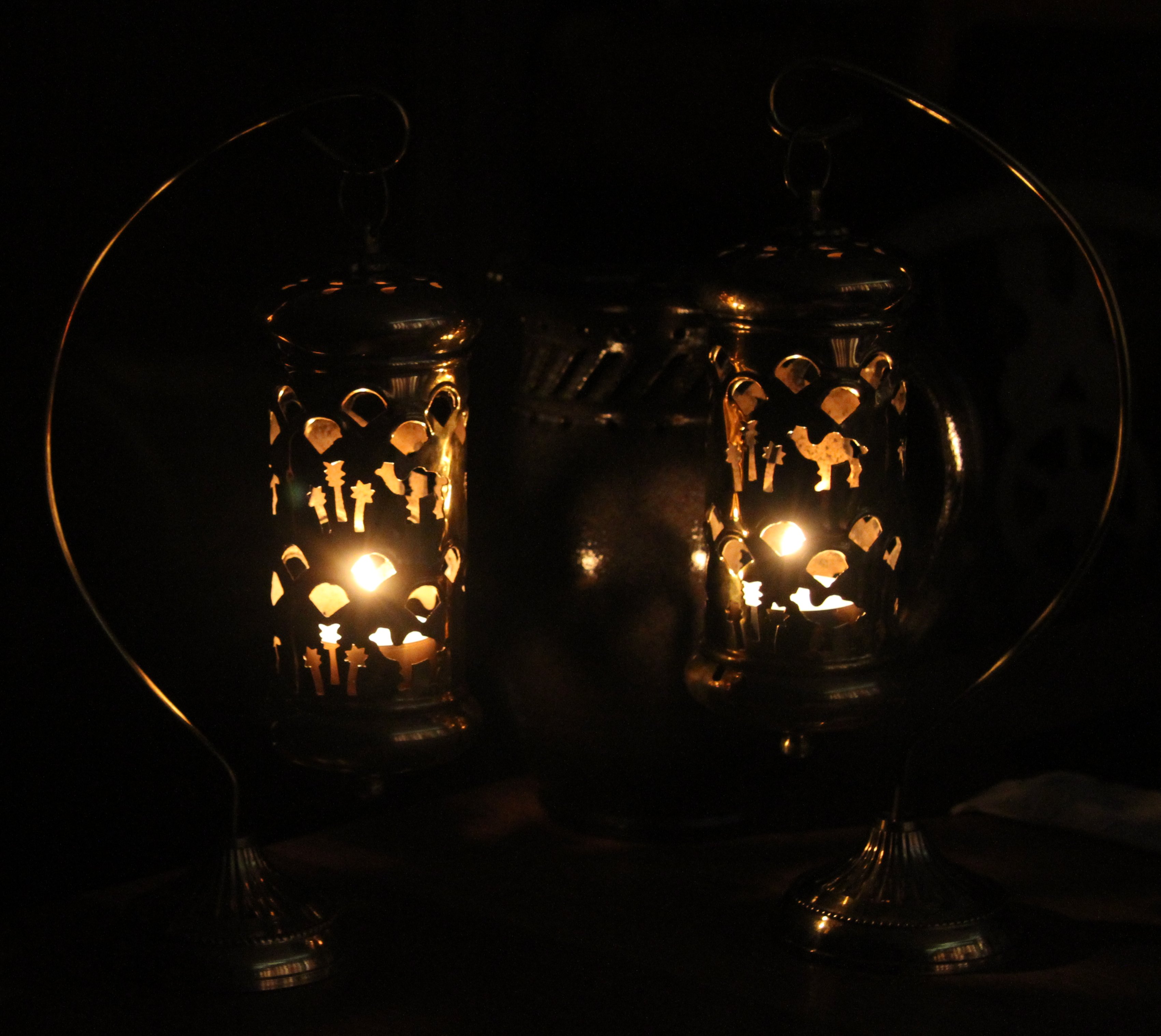
Before he came to visit this weekend, I had barely registered that his most recent trip away had been to the United Arab Emirates and he told me that in fact he had spent barely forty-eight hours there. Nevertheless, he managed to carve out a few minutes to discover and purchase a very fine pair of brass lamps. Shaped not unlike miners’ lamps, they are decorated with cut-outs, and designed to take household candles.
When I saw them, I was immediately reminded of the smoky corridors and dusky but splendidly-furnished lamp-lit private rooms of the King in One Thousand and One Nights to whom Scheherazade spun her nightly tale, each time leaving the King spellbound until she resumed her narrative the next evening. This is an art that has been somewhat lost to modern storytelling, though it was, of course, practised to perfection by Dickens and other famous Victorian writers who serialised their work in newspapers and magazines. I’ve read that Dickens and Thackeray were often still scribbling frantically while a boy from the magazine in question waited for copy on the other side of the door. I’d love to be able to write a crime novel in this fashion, but I suspect that it would be beyond my powers. I wonder if these writers plotted each work out in its entirety, or just made it up as they went along? And, if the latter, how did they manage to avoid the litany of inconsistencies and anachronisms that I have to iron out of my own novels once the first draft has been completed?
As for Scheherazade, what an example of a very clever woman, refined, charming, witty, knowledgeable across the disciplines and multi-talented! But her most remarkable skill was in her storytelling!
A location I have used in Almost Love… and there’s no ‘almost’ in my feelings about it!

It was a glorious spring day when I was in London in advance of my visit to Gower Street last Thursday. People were sitting or lying on the grass in the parks. The grounds of the British Museum were packed with museum staff, office workers and tourists, all getting their first proper burst of vitamin D from this year’s English sunshine. The mobile refreshments van parked just inside its wall was doing a roaring trade.
I didn’t need to take advantage of its services, because I had already visited one of my favourite London restaurants, an unassuming Spanish-owned eatery called El Parador. It is a brisk ten-minute walk from Euston station; the restaurant stands in the middle of the last parade of shops before Eversholt Street reaches Mornington Crescent (now there’s a name to conjure with!). On Thursday, I noticed for the first time that it is also immediately opposite the imposing edifice from which Levertons, London’s foremost undertaker, plies its sombre trade.
A family-owned restaurant, El Parador can lift your spirits with a burst of fine cooking on even the dreariest winter day. In the spring and summer, it is a festive place. Tables are laid in the garden. Both restaurant and garden are busy – there’s rarely a spare table after 1 p.m. – and the whole place buzzes with laughter, conversation and the tinkling of glasses. The staff – there are usually only two or three on duty – almost run between the tables, nimbly delivering a continuous stream of hot tapas dishes as they are ordered. Unequivocally, it serves the best tapas that I have ever eaten anywhere. My husband accompanied me there for the first time on Thursday and has already become an enthusiastic champion of the place.
I have another reason for liking it, though. The décor is plain, even homely. The tables are plain deal, the chairs of the simple round-backed wooden type still found in a few old-fashioned pubs. The walls are painted dark cream and, aside from a few small mirrors, there is little other decoration. Save for one thing: the bar, a glorious suggestion of a boat, is decorated with a flamboyant mosaic of pieces of tile, ceramics and mirror, all in shades of turquoise and black. It draws your eye as soon as you walk through the door. Pure 1960s, there is something lethal about its splendour. You feel as if a character played by one of the sex sirens of the ’60s – Jayne Mansfield, say, or Barbara Windsor – might come sashaying out from behind it and break off one of the pieces of mosaic to stab an errant lover through the heart.
I’ve written about this bar in Almost Love.
A personal expression of thanks…
I should like to use today’s post to express my gratitude to the members of my audience at yesterday’s ‘An Evening With Christina James’ at Waterstones Gower Street. They proved to be attentive, responsive and interactive, as well as very friendly; I was delighted that the occasion developed into a conversation (always much more natural and comfortable) which drew upon the combined personal experiences and expertise of some extremely knowledgeable people.
It was very kind of you all to take the trouble to come to listen to a couple of readings from In the Family and Almost Love and to my personal perspective on approaches to getting published. You are old friends and new and I am privileged as an author to count you as such.
May I also give my warm thanks to Sam and the Gower Street Waterstones for hosting this event!
I’m able to confirm the date of publication of Almost Love as June 15th 2013.







This book held me spellbound from start to finish…
I like reading history almost as much as reading fiction, as readers of this blog have probably gathered. My favourite periods are the later middle ages and the sixteenth and eighteenth centuries (the seventeenth century is too bloody and dismal unless I’m in a really upbeat mood). However, I enjoy history books from all periods and about most countries.
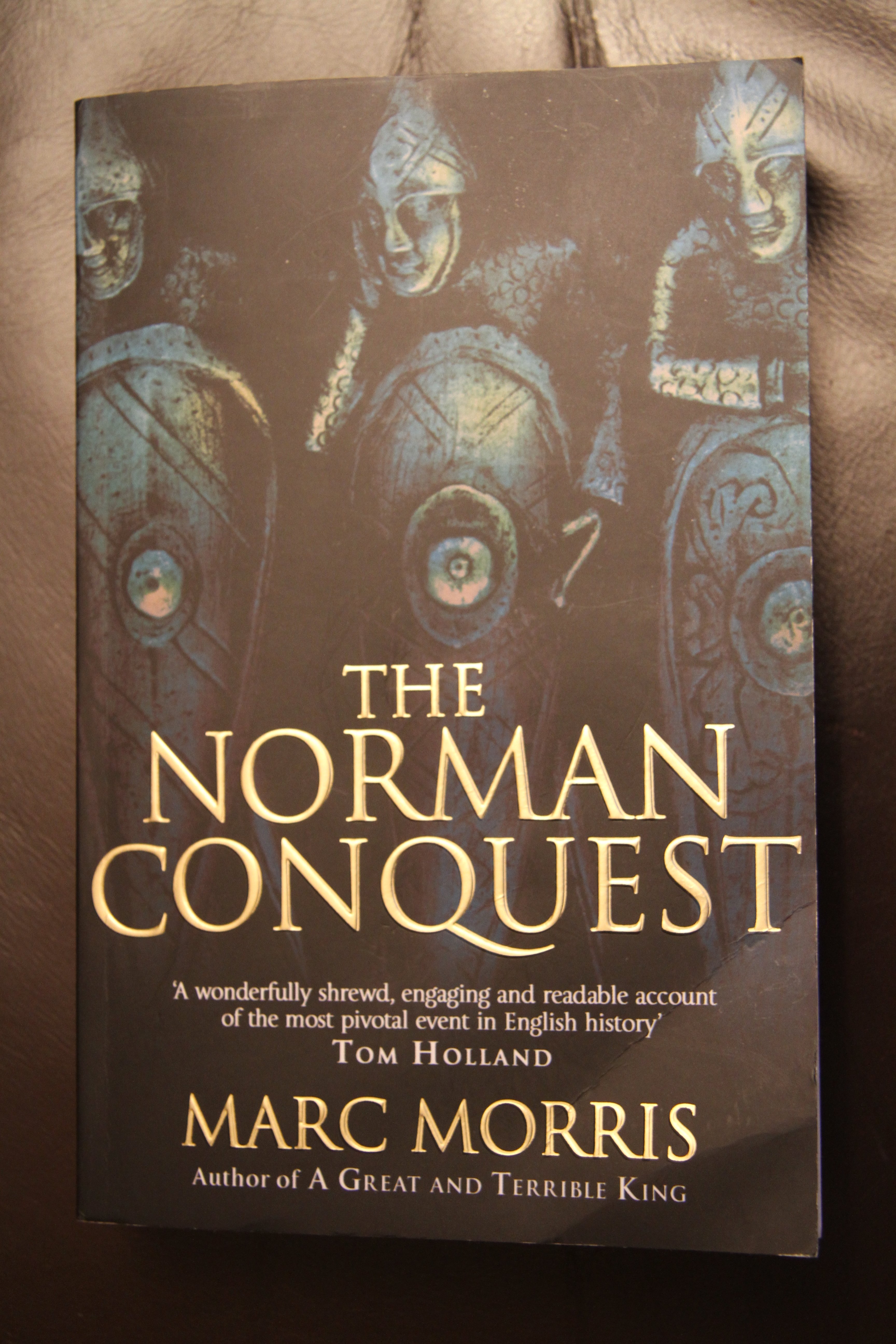
I’ve just completed The Norman Conquest, by Marc Morris and, although I’ve read accounts of the later Saxon period, the Domesday Book and the reign of Henry I, I’m almost certain that I haven’t previously covered the Norman Conquest itself. Morris’s work could actually be more accurately described as a biography of William the Conqueror: it covers the whole of his life and finishes with his death in 1087. However, it also gives detailed information about how Edward the Confessor ruled England and the events that took place immediately after his death that helped to precipitate the Conquest. The book is extremely well-researched and put me right about several common misconceptions. For example, William was actually Edward the Confessor’s chosen successor, so less of an upstart than earlier historians have implied; Harold was the son of Godwine, his treacherous leading aristocrat and eventual enemy, and had less right to the throne than William (though the claims of both were, strictly speaking, eclipsed by that of Edgar Atheling, Edward’s nephew); it was not unusual for bastards to inherit under Norman law; Harold did not march from Stamford Bridge to Hastings after he defeated Harold Hardrada, because he did not know of William’s invasion at that point and, in any case, it was impractical to move armies over vast distances unless in a foreign country where the land could be plundered with impunity – instead, the Northern army was dispersed and a fresh one mustered in the South after news of William’s invasion reached Harold; and, although the Battle of Hastings gave William a decisive victory in the sense that Harold, the anointed king, had been killed and therefore a power vacuum had been created for William to step into, William had but a precarious hold on the throne for many years after the Conquest and had to quell many risings and rebellions in all parts of the country, as well as hostile attacks from the Welsh, Scots and Irish.
Relatively little is known of William the Conqueror the man, but Morris takes what there is to paint a compelling picture of an early mediaeval magnate. When I wrote about Richard III, I pointed out that almost all mediaeval kings were murderers; William stood head and shoulders above most of them for his achievements in this respect. He was the archetypal soldier-monarch, slashing and maiming and killing, engaging in mass slaughter every year of his adult life. His worst murderous excess did not involve the use of any of these types of atrocity, however, but straightforward – if that’s the right word – starvation. When there was an uprising in the North, William simply laid waste the lands and left the people to starve. Pathetic accounts survive of whole communities, including children, dying en masse and of how some people took to the roads and walked hundreds of miles until they could find charity – one group walked from Yorkshire to Worcester, for example – only to die because their digestive systems could not cope with the food after so many months of enforced fasting. (Morris compares their condition with that of concentration camp survivors.) Dubbed the Harrying of the North, this is the one event in William’s career that even his most fervent apologists can find no excuse for. Morris, who on the whole seems to be pro-William, does not try. He confines himself to the observation that the calculation of the Anglo-Saxon Chronicle that 100,000 people perished in this way may be exaggerated, but of course there is no way of telling. William himself was said to be haunted by the Harrying on his deathbed.
However, somewhat surprisingly, but arguably justifiably, Morris makes some claim for certain civilising influences that stemmed from the Norman invasion. The Normans disapproved of slavery, and although it had been common practice in late Saxon England, it quickly died out after the Conquest. The Saxons took no prisoners, whereas the Normans believed that soldiers who had been fighting honourably on the other side should be captured (though they were more likely to treat well noble prisoners or those who could be ransomed, and their ‘clemency’ often did not prevent them from maiming their captives). Almost 500 years before Henry VIII, they tried to curb the power of the church; they also made it clean up its act, at a period when clergy were frequently promiscuous or co-habiting with women who had borne them children and nepotism and simony were widespread. Apropos of the church, this book has explained to me something that has puzzled me for years (although it might just show how slow on the uptake I am!), which is the role of the church in society. Because the book covers the very early Norman period, before the church had assumed many of the customs and ceremonies of the later mediaeval period, and because it was an unspiritual and pragmatic age, Morris is able to demonstrate clearly that senior clergy did not exist to promote the spiritual welfare of the populace. They did not even pretend to. They were administrators, some of them very capable and powerful ones, four centuries before Henry VII created posts for key councillors who effectively became the earliest civil servants.
William came to rather a sticky end. In his late fifties, grotesquely fat, and riding once again to battle – in France, where he spent 60% of his time even after the Conquest – he is said to have jolted violently against the pommel of his saddle, so that it became embedded in his overhanging gut. Alternatively, he had been sick of a stomach ailment for some time and may have died of natural causes. I love the extreme differences of the truth that these ancient chroniclers offer their readers: what they actually say is often less important than the moral intent that lies behind it. Thus there is a sub-text that William, the fat murderous bastard who had caused so many to suffer misery and horrible deaths, deserved a horrible death himself. And so the chronicler obligingly provides one… or perhaps he is telling the truth. These early historians would have made excellent novelists, if only the medium had been invented in their day.
Marc Morris, conversely, is an excellent historian who also tells a good story, but who is scrupulous in giving alternative versions where he finds them and indicating to the reader how likely it is that the truth has been exaggerated. Although I’m not enthralled by battles, blood and guts, there is so much more going on in this book that it held me spellbound from start to finish.
Mayflower turf wars… anyone else want to join in?
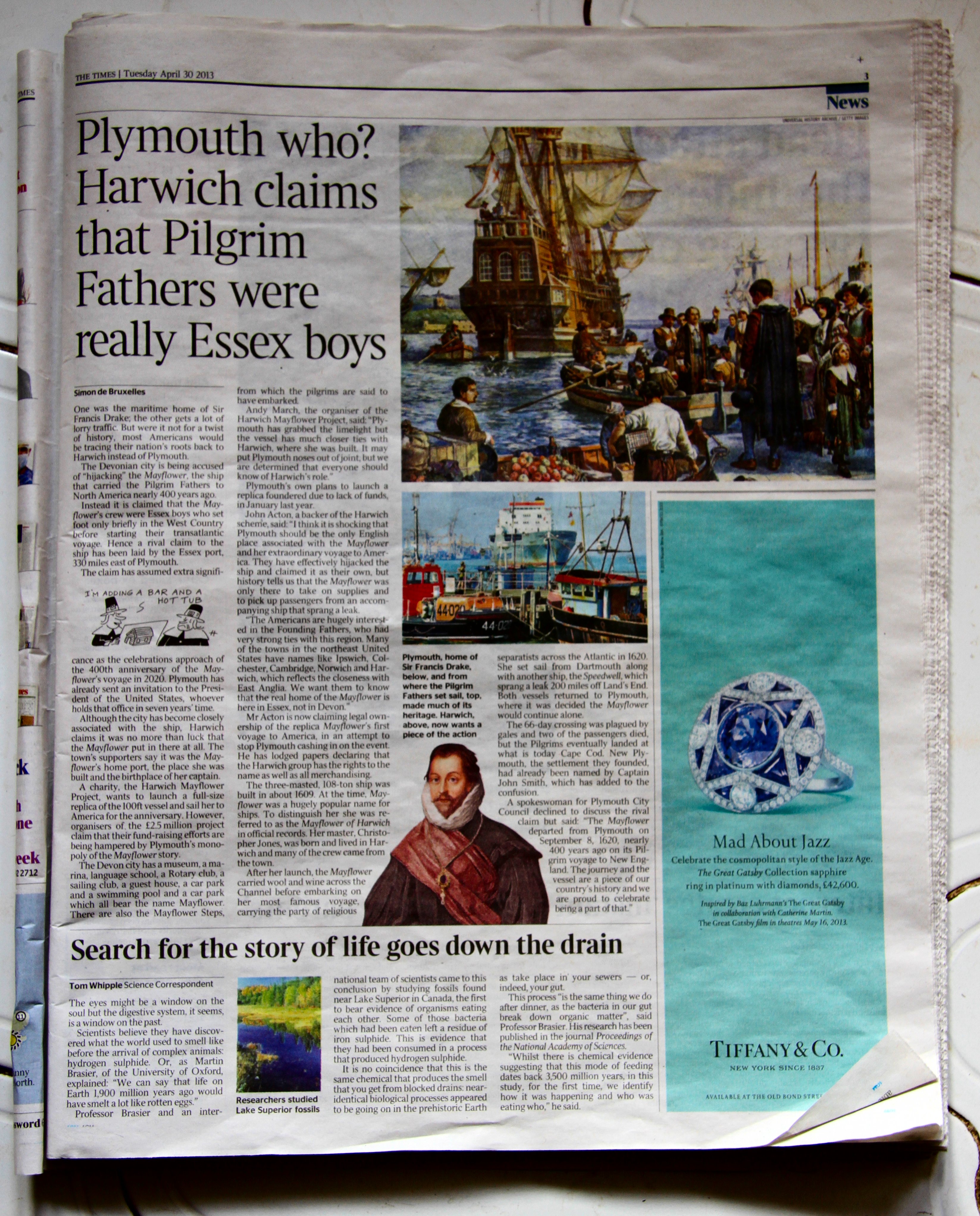
I was disgruntled to read in yesterday’s The Times that there is some kind of battle going on between Harwich and Plymouth about which place really ‘owned’ the Pilgrim Fathers and the Mayflower. Both contenders are quite obviously charlatans: as every Lincolnshire schoolchild knows, the Pilgrim Fathers originated in Boston, from which Fenland town they had to flee as dissenters to the Netherlands. Subsequently they sailed to America, and founded a colony in Massachusetts, eventually naming its principal town… Boston! (See? Not Basildon or Barnstaple. Or Plymouth, indeed!)
The name of Boston, now borne with pride by one of the world’s great cities, should be sufficient proof that all other claimants to ancestral Mayflower fame are upstarts. However, I do acknowledge that the name of the rock on which they landed in 1620, which has always been known as Plymouth Rock, muddies the waters a little. But I’ve seen Plymouth Rock and, no disrespect, in a country that does everything BIG, it is perhaps the smallest and most understated monument that ever graced the description ‘tourist attraction’: a refreshing change from the biggest, richest, fattest and brightest (but rarely oldest) that is the more usual fare in America; yet, even to someone who thinks that small is beautiful, disappointing, nevertheless. And far from casting doubt upon my assertion, I think that Plymouth Rock proves it completely. Why? Because, with its limited dimensions, it’s quite obvious that no more than three people could have stepped ashore upon it. 102 people sailed in the Mayflower; two of them died on the voyage. Of the remaining 100, three obviously came from Plymouth; and the other 97 from Boston. In the absence of a rock bearing the legend Basildon or Barnstaple, and with a whole city to rely on, I rest my case.
Lincolnshire rules, ok?
 Christina James, crime novelist