

Where There is Evil (Sandra Brown)

I have been both fascinated and appalled by the news this week that police have opened the grave of a man buried in Coatbridge, just east of Glasgow, because they think that it may contain the remains of Moira Anderson. She was a schoolgirl who disappeared late one bitterly cold afternoon in 1957, when she was out buying a birthday card for her mother. I am particularly interested in this new development because a couple of years ago, when I was unexpectedly stranded for some time at Peterborough station, I bought Where There is Evil, by Sandra Brown. Sandra Brown is the daughter of Alexander Gartshore, a Glaswegian bus driver and serial rapist and paedophile. The book was published immediately after his death in 2006 and makes a strong case for his having sexually abused and killed Moira Anderson. Moira’s disappearance was noticed immediately, because she belonged to the tight-knit community in which Sandra herself grew up; a large-scale search was mounted for her. Her body was never found. Chillingly, Sandra says that she suspects that Gartshore also killed children who came from the fringes of society; consequently, some of them may never have been reported as missing. Since the news about the exhumation was announced three days ago, she has also compared her father with Jimmy Savile, saying that the number of crimes that he committed was probably comparable. As Savile is suspected of having been, she thinks that her father was probably part of a paedophile ring.
This book made a huge impression on me. I couldn’t get it out of my mind for a long time after I read it. A key reason for this was the sheer matter-of-fact way in which it is written. There is no need for Sandra Brown to sensationalise what she has to say: her horrific story needs no embroidery. Her account of the casual brutality of life in a working-class Glaswegian community also shocks; it goes a long way towards explaining how men like Gartshore managed to hide, like Savile, ‘in plain sight’. As a child, Sandra spent much of her time protecting and supporting her downtrodden mother. She tells the heart-rending story of her mother’s pathetic gratitude when Gartshore gives her the money to buy a new grate for the fire. Sandra’s innocent puzzlement and embarrassment when her friends are forbidden to visit her house (she never finds out why; the implication is that Gartshore has made some kind of obscene overture) also sticks in the mind, as does her recollection of being sent to the bus depot with her father’s packed lunch, to find him on the floor at the back of his bus with a conductress whose knickers are protruding from his back pocket. Sandra herself eventually escapes by winning a place at university and the full maintenance grant (which she shares with her mother and still manages to survive) that accompanies it. She goes on to become an eminent teacher and patron of a charity that helps abused children.
If the remains of Moira Anderson are found in the grave at Coatbridge, I suppose that it may bring some kind of ‘closure’ (that word so well-worn by the media) to her now elderly siblings. But Gartshore, like Savile, will never now be made to face the reckoning. All the signs were there; even his own father said that he thought that his son had committed the murder. How many more children were abused and killed after Moira died because no-one in authority really wanted to listen?
Bare bones
 The landscape may now be bare, but it is beautiful in its skeletal outline. I love leaves, but the winter scene has shape and structure and filigree form that catches the eye and holds it, particularly when a tree stands alone and has grown with all the advantages of light and space into its true adult character. I love the light in January, too, especially in the late afternoon of a clear and frosty day, when the trees stand out against a Jan Pieńkowski sky; there is exquisite contrast of black against that glorious blue and the very essence of the natural world is revealed.
In crime fiction terms, the tree’s winter skeleton is the Agatha Christie of plots: precise, ingenious and with no unattached loose ends. (Rankin does a dandy plot, too.) Intricacy and artifice combine in a natural, convincing and connected story that conforms to the conventions of crime novels. Writing such is a challenge; published authors sometimes acknowledge that they have only a vague idea of plot when they start to write and just allow it to unfold; some admit that they don’t do it in order – I’m not sure that the anguish of plot uncertainty is worth it, especially if the chapters and sections end up across the carpet in an effort to pull the pieces together! Getting the right degree of complexity (too much and the reader is flapping helplessly around in the branches; too little and there is insufficient challenge) is essential and, for me, sub-plot interest and alternative narratives make for appealing additional subtlety. That’s not to say that plot is everything, but a clear view of the structure is fundamental to a novel’s success. I’m working hard at my second and looking out of the window with envy at an oak tree’s perfect form.
No, not the best plot device for me…

It seems an incredible irony that the more developed our society becomes, with the undoubted benefits of technology and communication, the less kind it seems to be (There ought to be plenty of advantages for the crime writer in that!). For example, with the mobile phone came theft, intimidation and bullying, as schoolchildren were quick to discover; camera-enhanced phones only worsened the problem, as ‘happy-slapping’ ensued.
Now, as the phones become smarter and smarter, people’s capacity to exploit them for malicious purposes seems to grow and grow. How different was the mobile-less world of my childhood, which had only public telephones with buttons A (which you pressed to speak once the call got through) and B (to get un-used money back). Even then, the human mind was looking to exploit an opportunity: young children (self included!) always nipped in to press button B in the hope that someone had forgotten to retrieve their pennies (the big coins of pre-decimal days) and there were naughty ways of clicking the receiver to make free calls (though I was too young to master them!). Nevertheless, I don’t think people were particularly at risk from using a telephone box, whereas now a mugger on a bike will snatch a phone from someone’s hand and make off with it; parents now provide their children with a phone to improve their safety and by doing so increase the risk of danger.
For me, mobile phones are a very mixed blessing, as some excellent and very humorous bloggers of my acquaintance have recently confirmed. I hate having to listen to other people using them, which they seem to do all the time on train journeys; the battery on mine is always flat at the time I really need to make a call; my husband’s phone is invariably switched off when I call him (Read into that what you like!); someone rings when I’m taking a quiet walk in the countryside; I could go on and on. Worst of all, though as an owner of one I ought to be completely au fait with how it works, I’m not conversant with its finer capabilities and I certainly know that I won’t be using it as a plot device any time soon, because there would inevitably be a glaring technical error for all to laugh at! I’m not keen on procedurals, anyway.
Chopped up and served. Chianti, anyone?

Last week I wrote about situations that I’ve encountered that have literary potential. Today I’d like to focus on one of the characters I’ve met who has made a similarly lasting impression on me.
His name was Moon. I don’t know if this was his real name, an onomatopoeic approximation of his real name, or a translation of it. Perhaps he had adopted a simple, monosyllabic appellation because he was fed up with people’s mispronunciation of his real name all of the time.
He was a Chinese chef in the takeaway that I worked in as a student when I returned to Spalding for the holidays. Unlike Henry Pang, the lithe, diminutive owner of the business (and married to Hilary, a Lincolnshire lass through and through), Moon was massive, tall and broad, with big bones and – no pun intended – a large round moon face.
Other than the shop, he had no home. He slept on a mattress in the store-room above it. The premises were situated in one of the eighteenth century terraced buildings in New Road, and perennially dark. The ground floor of the building was divided into two: the shop at the front; the kitchen behind it. Moon seemed to spend all of his time in the kitchen or the store-room. He never went out. It occurs to me now that he may have been an illegal immigrant.
He never spoke to me and I didn’t know how much English he understood. He took the orders from a menu that I had marked up. He never cooked the wrong dishes, but I wondered if he could read what was there or whether Henry had helped him to memorise which items occurred where on the list.
Moon was a dab hand with a cleaver. The one that he used was massive and rarely out of his sight. He would take it in his huge fleshy hand and cut mushrooms and chestnuts into exquisite wafer-thin slivers.
Business was brisk at the takeaway on Fridays and Saturdays, but often slack on other days, especially Mondays and Tuesdays. Then I would sit in the shop from 6 p.m. to 10 p.m. with nothing to do but read a book. Moon would wait in the kitchen.
My friend Mandy, who had taken a year out between school and college and was working in the public library, would sometimes call in for a chat on her way home from work – or on her way to spend an evening in the pub with our other friends. I was already fascinated by the Jack the Ripper stories and had ordered from the library a book that had just been published about them. (Here I pause to pay tribute to the tiny library in Henrietta Street, which throughout my school and student years never failed to get for me a book that I requested, however arcane the topic.) We opened the book at the photographs and shuddered at the picture of Mary Jane Kelly’s intestines draped around the room in which she had died.
Moon appeared, to see who was with me in the shop. He stood in the doorway for a few moments, clutching his cleaver, before disappearing again into the murk of the kitchen.
Mandy had at least as vivid an imagination as I: “Never mind Jack the Ripper,” she said as she was leaving, “what about Moon the Ripper?”
I spent the rest of the evening sitting on my stool in trepidation, scared to look at the book any more, hoping that Moon was too busy chopping mushrooms to be entertaining murkier thoughts of the uses to which he might put his cleaver.
To know, or not to know?

Naïvety: I remember it well – those childhood days of innocence, which seemed to last forever and knew nothing of crime, or violence, or death, or war, or hatred. If I may mix my cultural myths, the succulent temptation of the fruit of the tree of knowledge or of the contents of the jar which was Pandora’s ‘box’ were there, but parental guidance and control outweighed any desire to eat of the fruit or to open the box. Vague parental warnings about threats to personal safety had all the potency of magic charms and miraculous powers of protection.
Then (to add more metaphor to the mix!) gradually, drip by drip, the small bright pool of understanding which had reflected a cloudless blue sky and sparkling sunshine grew deeper and wider and darker; it should have been frightening, but, ironically, the desire to know what lay beneath and beyond it was too great.
Eve, Pandora and I, together with the rest of the world, discovered evil; with what result? Our own sorrow and suffering? Certainly not! With the loss of naivety came, for me, the excitement of discovery of things forbidden (such as the reading of books and the watching of films that would have had my very religious grandmother revolving in her grave) and, as well, the knowledge and increase of understanding to deal with the evil of life and to challenge it.
Asked by a friend why I wanted to write, of all things, about life’s horrors, I found it easy to reply: facing demons is better than pretending they don’t exist; there is more value in the goodness of life when it has evil as a foil. Our best literature reflects this again and again. And, once all the nasties had poured out, there was one thing left at the bottom of Pandora’s box: hope.
By the by, I was naïve when I first went Twittering; now I’m on my guard against spurious ‘followers’ and the hidden viral traps that pop miraculously into ‘interactions’; knowledge is power… and my self-defence is the stronger for it!
Tricked into hope?
 I know that the weather is unseasonably mild at the moment. Even the honey-bees have been flying, now that the light is changing and there are glimpses of sun; nor are they without hope of pollen, if not much nectar, as the gorse is flowering here, primulas are out and the snowdrops are swelling into white droplets of beauty amongst the new spears of grass. Three great skeins of geese flew over this morning, heading north-west in honking trails, suggestive of a spring to come. And, although the mud is still with us, the last few fine days have caused the worst of the surface water to drain away.
Yet the weather forecast says that it will get colder towards the end of the week, when we’ll probably feel that we’re in the grip of winter again. I know from bitter experience that it’s possible to be deluded by false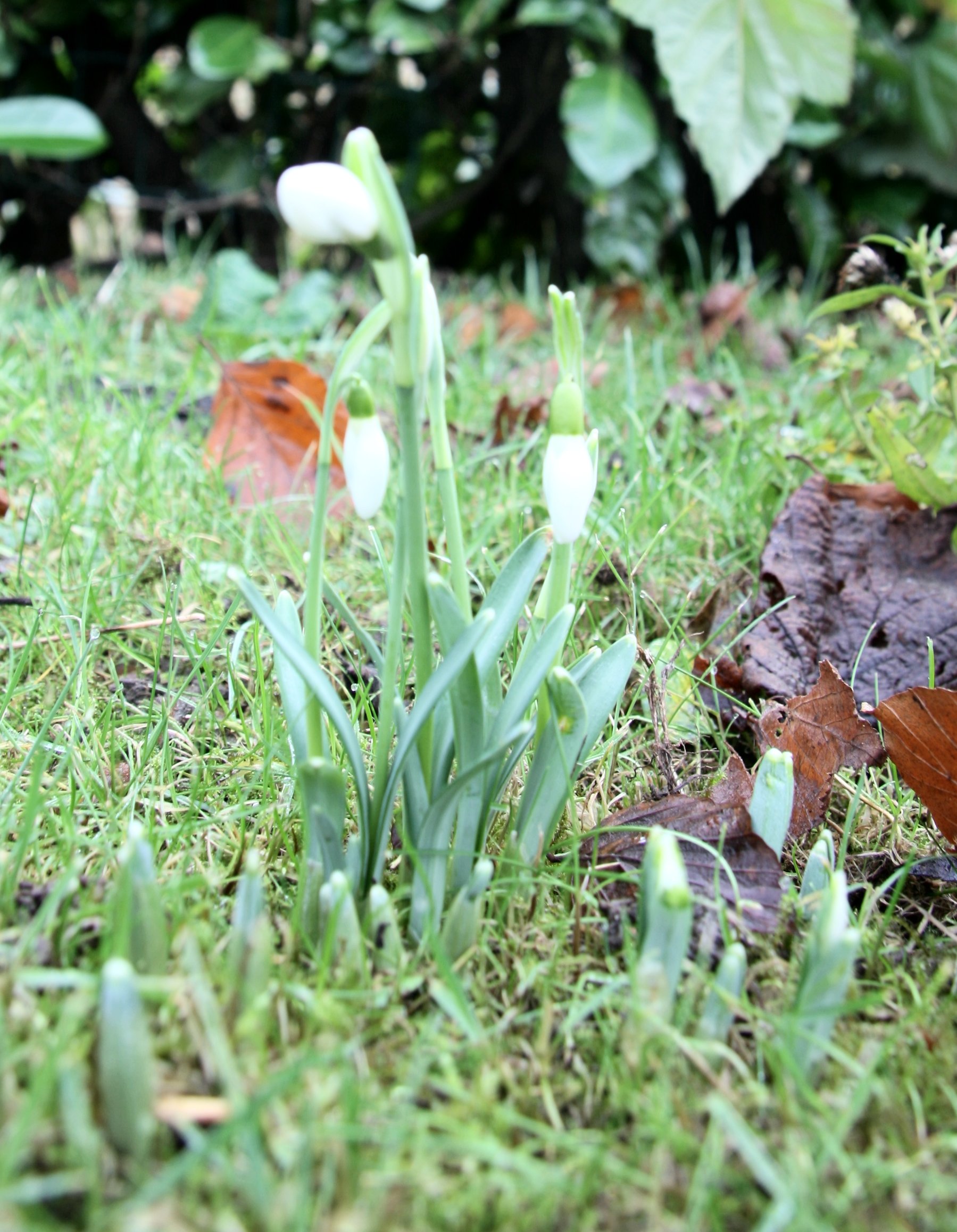 hopes of an early spring; I fear that the primulas, snowdrops and geese are all beguiled by the writer of the natural world, who has penned a false conclusion to a story of darkness and destruction, tricking them into feeling that all is well, whilst the villainous winter has another few chapters of unexpected violence. We have still to get through February, which is, statistically speaking, the coldest month, and the one I always dread the most; good month for murders, February!
We take heart, however, that goodness will prevail and we search among the winter words for clues that the forces of warmth and light are gathering. The birch-tops are already turning their beautiful smoky purple as their buds swell and it will soon be January 21st, when the darkest two months of the year will be past.
Grim Pickings (Jennifer Rowe)

Grim Pickings, by Jennifer Rowe, reached me by a roundabout route. It was given by a colleague to my son, when he was travelling and had nothing to read. (Small smile here, as he is Mr. Right-Up-To-Date Technology, but somehow hadn’t managed to upload any e-books for his trip.)
I have found reading it an uneven experience. Set on a remote Australian apple farm, it is intended as an Australian take on the country house murder mystery. This is an ambitious and interesting concept, but one that straightaway hits a problem: the British class system is usually a key factor in country house sagas. Jennifer Rowe has somehow to create a power hierarchy within the much more egalitarian Australian setting that she is writing about. She tries to do this by depicting a matriarch, Betsy Tender, who holds psychological sway over most of the other characters. Although Betsy is quite well-drawn, I feel that this is not entirely successful.
The characterisation and the quality of the prose are at times pretty shaky, sometimes even reminiscent of the romantic stories that used to be published in old-fashioned women’s magazines. Nevertheless, although I found the book by no means un-put-down-able, I did read it to the end (as did my son), not through any resolution grimly to carry on, but because I genuinely wanted to know how the murder, with its accompanying clues scattered throughout the plot, would be solved. The plot is the novel’s strong point: it is complex but believable, both carefully and ingeniously constructed.
My interest only began to wane fifteen or twenty pages before the end, when the murderer is identified and a very long-drawn-out denouement begins. I must admit that I only carried on reading at this point because I thought that there would be some extra twist at the end. No such luck!
I’ve just Googled Jennifer Rowe and discovered that she started her writing career as a children’s author. Grim Pickings appears to have been her first novel for adults (and was apparently made into an Australian mini-series). Despite my reservations, I may try reading some of her later work if it comes my way.
Sexy settings…
If you have been reading this blog for any length of time, you will know that settings are important to my writing. The ones that I write about are often taken from life, though of course adapted or otherwise presented through a glass, darkly. I count myself fortunate in having a good memory – for things that interest me! If they don’t, I am at a loss; I am completely baffled by our motorway systems, for example. I can often recall in vivid detail people and events from a long way back in the past. I’m also very lucky that I have sometimes been the passive and curious observer of some very interesting settings, a couple of which I’ll share here:
When I was a postgraduate student, I lived in a flat in Brudenell Road in Leeds, which was (and still is) quite a run-down area. My room overlooked a ginnel (local dialect for an alley or a snicket!), beyond which were the back doors of a row of terraced houses. A great many men seemed to come and go at all hours of the day to the one immediately opposite my window. Occasionally, a woman appeared, framed in the doorway and wearing her dressing-gown. Being a naïve girl from Lincolnshire, I needed a boyfriend to tell me that it was what he called a ‘knocking-shop’. I watched the to-ings and fro-ings all the more avidly after this.
Just before Christmas, my flat-mate’s mother came for shopping in Leeds and stayed for the night. She and my flatmate slept in my room, which had a double bed, and I moved into the other one. In the morning, when her mother appeared, she was haggard and exhausted. “Thank goodness you weren’t sleeping in there last night,” she said. “There was a police raid on that place over the road, and we didn’t get a wink of sleep.” Damn! Damn! Damn!

Much more recently, I made a short visit to Russia to conduct some seminars for a group of Russian librarians who worked for a charity which had been set up to supply e-books to poor Russian students. The seminars lasted for several days. The charity had arranged for us to stay at a conference complex about thirty miles outside Moscow, explaining that, if we met in Moscow itself, the librarians ‘would only try to escape’. I was somewhat alarmed by this until I realised that it meant only that they might try to do a bunk from the seminars, lured by the attractions of the city. Nevertheless, the conference centre was quite an intimidating place. It had been an old KGB sanatorium and was still guarded by troops (who, I was fascinated to observe, wore different coloured combats every day – while I was there, they were resplendent successively in blue, brown and green). The rooms in the centre were luxury itself. Not much austerity seems to have been practised by the KGB! The carpets were all knee-deep wool pile, and all the bedrooms had fantastic marbled bathrooms. The food was a little strange: Meals consisted of many courses, almost every one featuring pork. There was no wine, but every night new bottles of brandy and vodka were placed on each table (which seated four people). In the reception area, a huge parrot with exotic plumage sat on a perch, neither shackled nor perturbed by the constant stream of human traffic. There were extensive grounds, bounded by the river Moskva. I walked down to the river one day with one of the librarians. An old sign leaned crookedly on the bank. “What does that mean?” I asked. “Oh,” he said. “It says that anyone trying to swim across the river will be shot!”
I honestly haven’t made a word of this up! It is raw material, still to be worked on by passing it through the dark glass. I may even have to tone it down, in the interests of credibility.
Spalding: a setting for ‘In the Family’, but more to it than that…

The Pied Calf, in Spalding’s Sheep Market
When I returned to Spalding recently for a signing session at Bookmark, I was struck by the beauty of this old town, the layout of which has remained essentially unchanged since the eighteenth century. Because it was a market town to which livestock were driven for auction – there were various market-places, such as Hall Place and what is still called the Sheep Market – the approach roads were made broad and straight at a time when streets in other towns were narrow and winding. The River Welland also makes a significant contribution to its character. Deep and full, with steep banks that have been fortified in places, within living memory it carried ships to the town from the Lincolnshire coast. I myself can remember the grain boats that were still plying their trade between Fosdyke and Birch’s, the cattle cake merchants in the High Street, when I was a primary school child.
While I was growing up in Spalding, however, I was pretty impervious to its charms. I was impatient to leave what seemed to me to be an intellectual backwat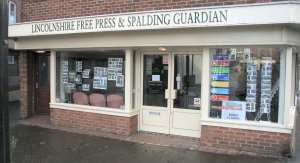 er where sugar beet and tulips were the main topics of conversation, the Young Farmers’ Club dominated social events and the local newspaper – the Spalding Guardian – was full of photographs of girls who had been a few years ahead of me at school, now smiling and swathed in Nottingham lace, marriage being the traditional rite of passage of a farmer’s wife. This was not the life for me. I sought the wider horizons that I believed a university education could give me.
Therefore it was with a certain sense of irony that I set the DI Yates novels in Spalding. I acknowledge now that Spalding gave my young self many more gifts than I could appreciate at the time: a sense of community, the genuine interest that professionals – teachers, clergymen, doctors – showed in helping me to fulfil my ambitions, a safe environment where my friends and I could wander freely with no adults present. Now, almost unexpectedly – I did not at first plan to give Tim Yates a home and a career in Spalding – I continue to benefit from its bounty. Perhaps it has always been a benign presence at the back of my subconscious. Perhaps now I also know that exploring those wider horizons was not necessarily as rewarding as what I had to start with.
Living with killers

In common with most country people who keep a dog and a cat, I am able to let them have a bit of freedom. This inevitably means that I live with two occasional killers! I have changed their names to protect their privacy. For the purposes of this post, I’ll call the dog Dogberry and the cat Verges.
Dogberry works with military efficiency and is hard-wired to hunt pheasants (No-one taught him; it is instinctive.). Though not a working dog, he has all the skills of one and killing is not normally a part of his m.o. – he sees his role purely as the silent marker for firepower (He must be very disappointed by its failure to materialise.). However, once in a while, he does come hard upon a bird by accident and the temptation at such close quarters is too much for him. With no warning and no malice aforethought, he is a clean and clinical. He doesn’t conceal the body, either. Afterwards he expects commendation for a job well done. Ah.
Verges is a loner who kills for his own amusement. He chooses his victims from two demographic groups: the down-and-outs of garden society (mice and rats) and those more integrated within it whose deaths involve taking risks (all birds). He exhibits a psychopath’s mentality. If the victim is a mouse, he will taunt it and play with it until he gets bored or is caught red-pawed, when usually he will deliver the coup de grâce. If he is distracted (perhaps by the Law in pursuit) the mouse may escape, but rarely will it recover. When the man from British Gas makes his annual visit, Verges is exposed as a serial killer: inevitably, a row of tiny skeletons or mummified bodies will be discovered under the boiler.
Birds are another matter. Verges understands that there is legislation against harming them. Most of the time he observes the law, but if something happens to disturb his equilibrium – say, being exiled to the lobby on a cold day (outrageous!) or inconvenienced by a visiting dog (the folly of it!), he will exact revenge. Birds can’t be played with like mice (too prone to escape and actively protected), so they must be snatched and dispatched with speed. Afterwards, Verges lies low for a time until the hue and cry is over.
When relaxing at home, Dogberry is a gentle and subservient friend and Verges a more uncertain companion, a feline Cesare Borgia who may purr civilised greetings whilst ever concealing the spiked weapon within the velvet. Their felonious lives are left outside, though. Not for them the country house murder. I’m glad to say.
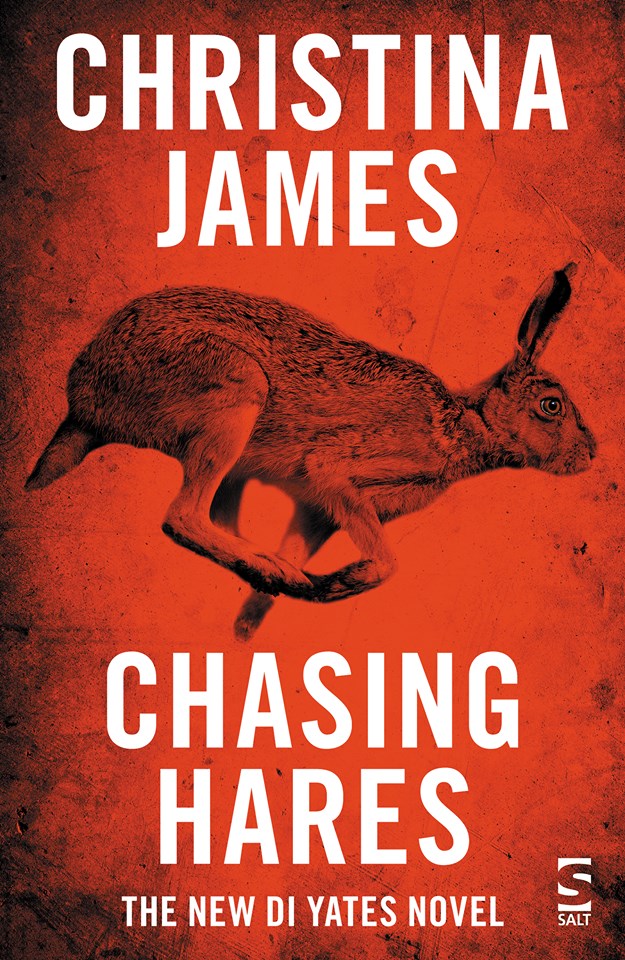
 Christina James, crime novelist